India Is Building Battery Storage Fast. Fire Safety Has to Evolve With It.
Hyderabad, India –
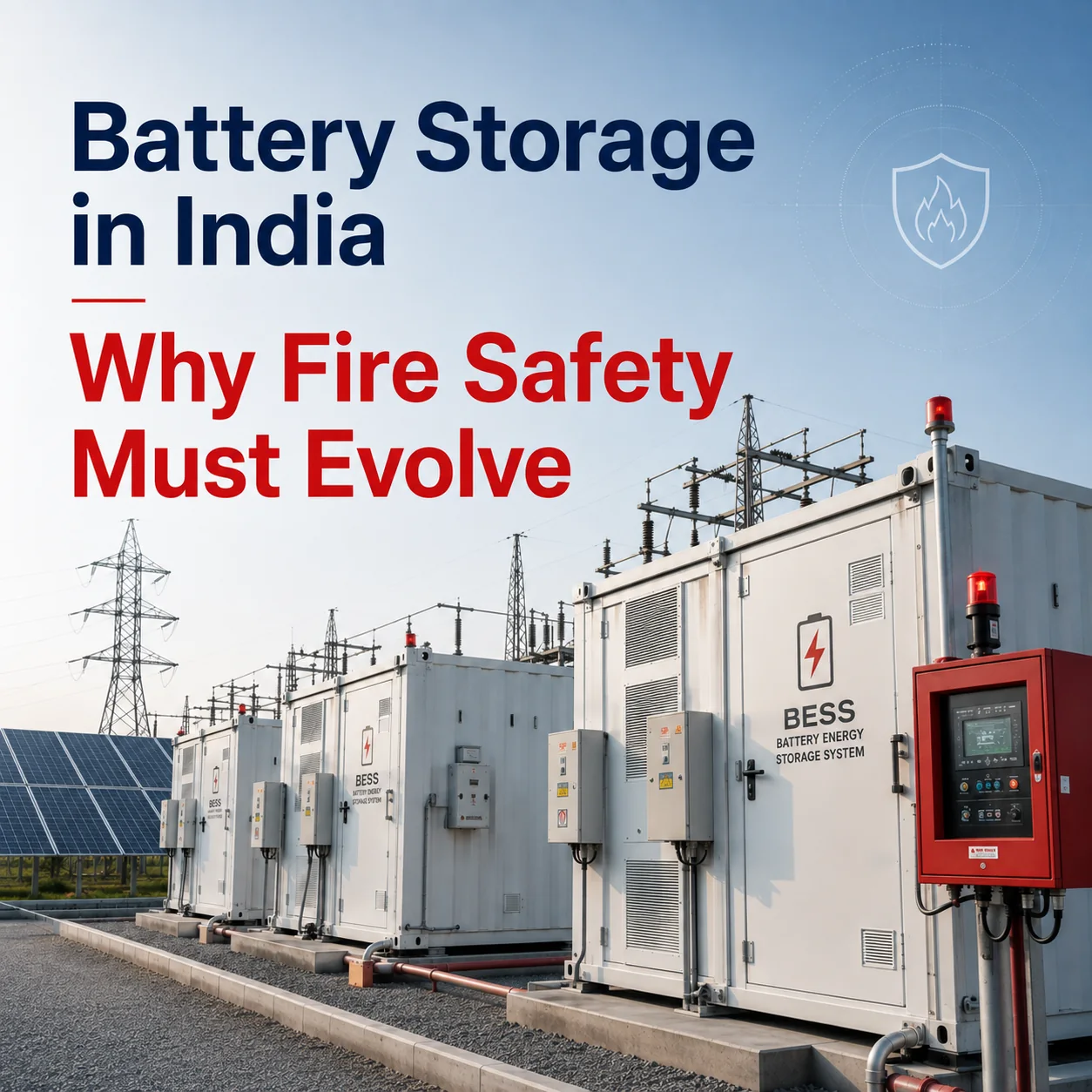
Battery energy storage is moving quickly from a specialist technology to an important part of India's electricity infrastructure.
Solar and wind can generate enormous amounts of power, but generation does not always coincide with demand. Battery Energy Storage Systems (BESS) help bridge that gap by storing electricity when it is available and releasing it when the grid needs it. The Central Electricity Authority now tracks battery-energy-storage deployment in India through dedicated project reports.
As deployment accelerates, however, another part of the infrastructure has to develop alongside it: fire and life safety.
The challenge is that protecting a large lithium-ion battery installation is not simply a matter of selecting an extinguisher or installing a conventional suppression system.
A battery failure can involve thermal runaway, combustible gas generation, fire propagation, re-ignition and explosion hazards. The behaviour of the battery itself therefore becomes part of the fire-protection problem.
That is turning BESS protection into a much deeper engineering discipline.
Why BESS Changes the Conventional Fire-Safety Approach
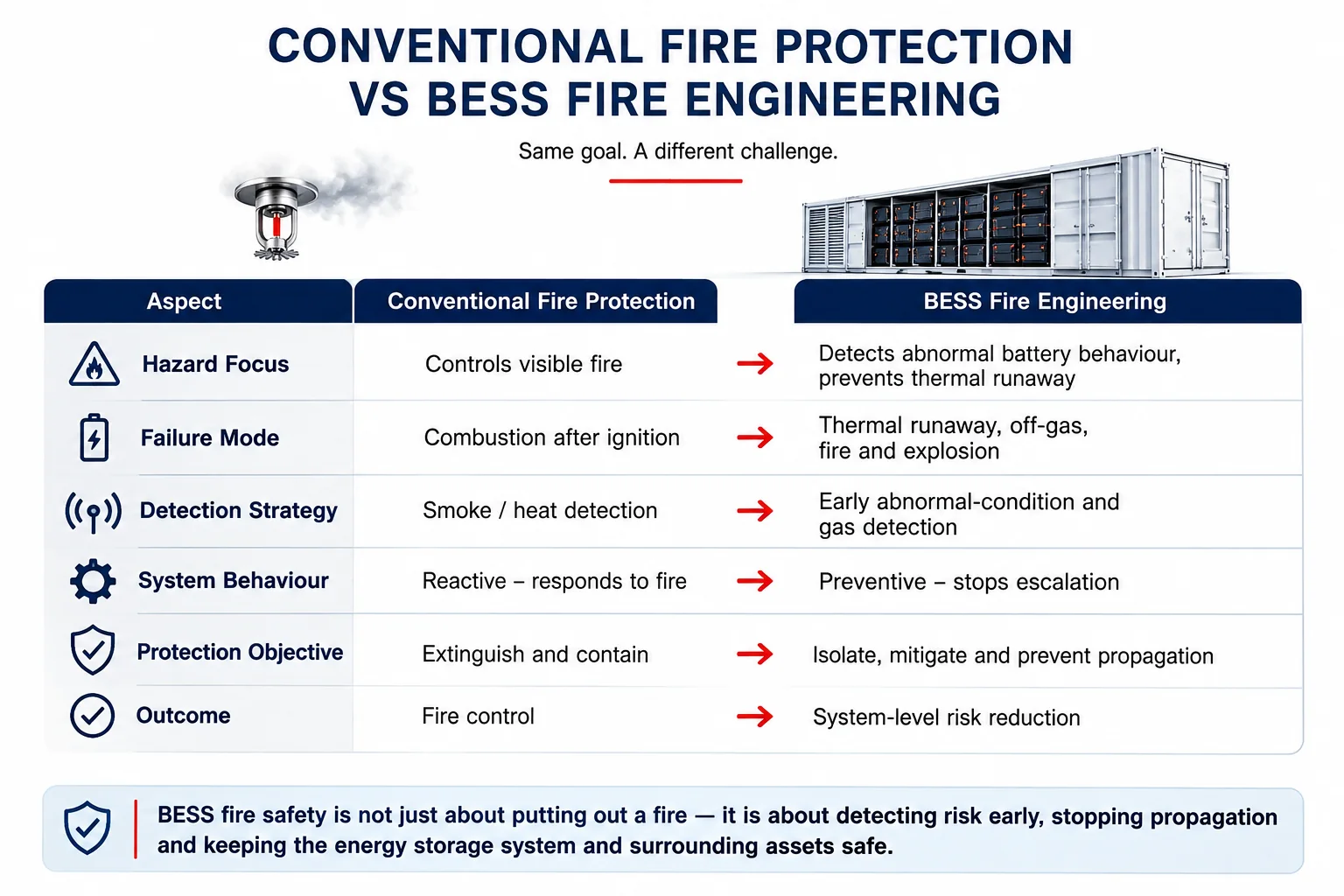
Most conventional fire-protection strategies are designed around detecting and controlling combustion once a fire begins.
Lithium-ion batteries introduce an earlier failure process.
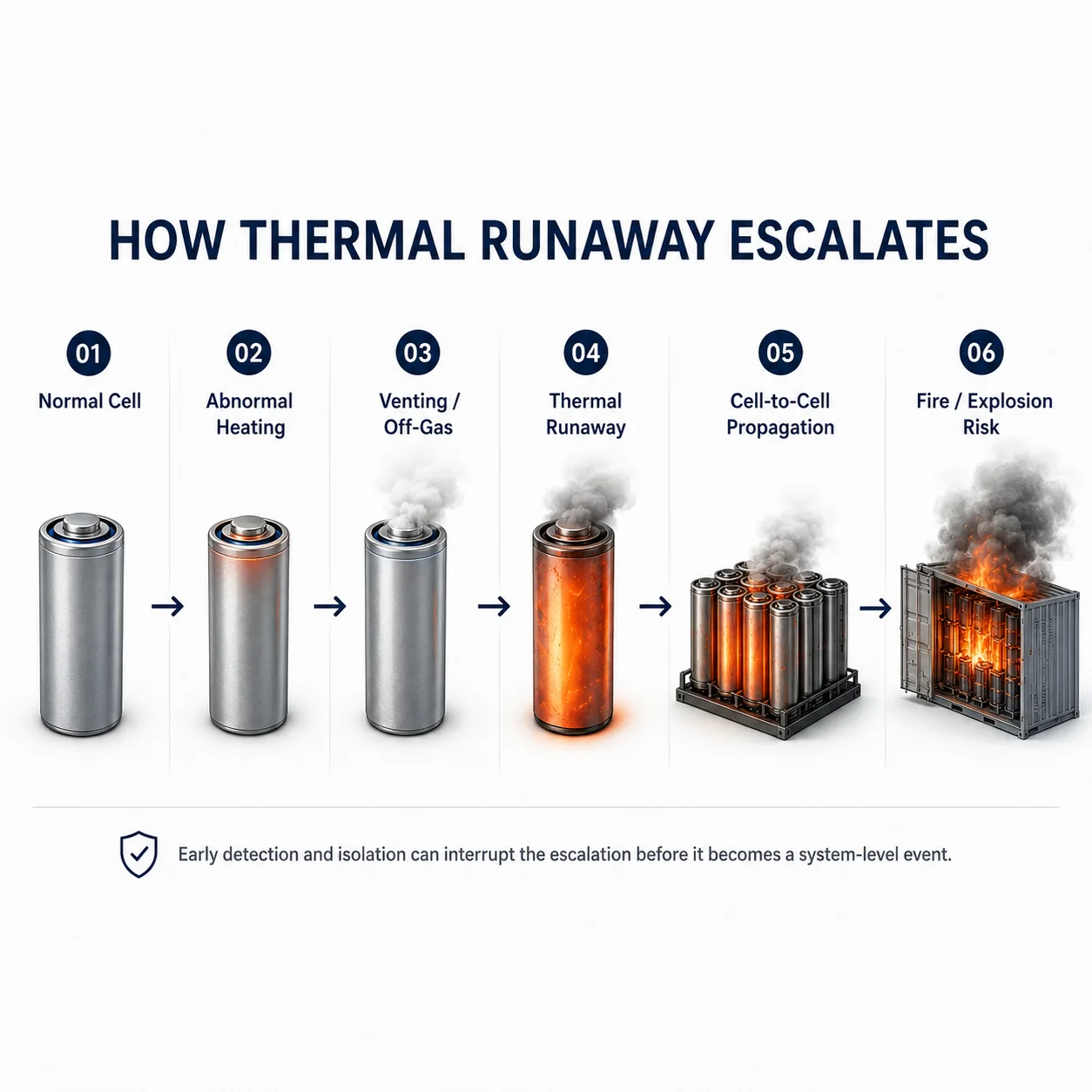
A cell can be pushed outside its safe operating limits by factors including internal defects, electrical abuse, mechanical damage or excessive temperature. Under certain conditions, this can initiate thermal runaway.
Thermal runaway is a self-heating failure process in which the temperature of a battery cell rises rapidly as internal reactions generate additional heat.
Once initiated, the process can become difficult to stop.
More importantly, a failing cell can transfer heat to neighbouring cells. If enough energy reaches them, the failure can propagate through a module, rack or larger portion of the battery system.
Research and testing by energy-storage safety organisations continue to focus heavily on this propagation problem because real installations contain large numbers of cells positioned close together.
This changes one of the fundamental questions in fire engineering.
How do we detect an abnormal battery condition early enough to prevent one failing cell from developing into a larger event?
The central BESS fire-engineering question
Instead of asking only how to extinguish a battery fire, engineers also have to ask how to interrupt the failure before it propagates.
A BESS Incident Is Not Only a Fire Problem
Fire is the most visible hazard associated with battery failure, but it is not the only one.
During thermal runaway, lithium-ion cells can vent gases. Depending on the battery chemistry and failure conditions, this mixture can contain combustible and toxic components.
Inside an enclosed BESS container or battery room, those gases can accumulate.
If the atmosphere enters a flammable range and an ignition source is present, the incident can develop into a deflagration or explosion hazard.
This means the protection strategy has to consider several hazards at the same time:
- abnormal battery behaviour
- thermal runaway
- cell-to-cell and module-to-module propagation
- combustible and toxic gas generation
- fire
- explosion
- electrical hazards
- re-ignition
- safe emergency response
No single detector or extinguishing agent addresses all of these problems. Modern BESS fire safety therefore depends on layers of protection.
Layer 1: Prevent the Battery From Reaching a Dangerous Condition
One of the most important fire-safety systems in a BESS installation is not necessarily part of the conventional fire-alarm system. It is the Battery Management System (BMS).
The BMS monitors operating parameters such as cell or module voltage, temperature, current and state of charge. When abnormal conditions are identified, the system can generate warnings and, depending on the design, initiate protective actions.
Thermal management is equally important.
Battery performance and safety are strongly influenced by temperature. HVAC, liquid cooling, airflow, battery spacing and the physical arrangement of modules can therefore contribute directly to risk reduction.
This is why BESS fire safety begins before a smoke detector or suppression nozzle is ever installed. It begins with the battery system itself.
Layer 2: Detect Failure Earlier
Conventional smoke and heat detection remain important components of battery fire protection.
But battery failure creates an opportunity for another type of detection: identifying conditions associated with the cell before a developed fire exists.
A lithium-ion cell can vent gases as it moves toward or enters thermal runaway. Sensors capable of detecting relevant gases or volatile compounds can therefore potentially identify an abnormal condition earlier than systems that depend only on visible smoke or significant temperature rise.
Depending on the application and validated detection strategy, this may include monitoring for compounds associated with battery venting or changes in the atmosphere within an enclosure.
The value of earlier detection is not simply a faster alarm. It creates the possibility of earlier intervention.
- isolating affected equipment
- stopping charging or discharging
- disconnecting electrical sections
- changing ventilation operation
- notifying the site control system
- initiating emergency procedures
- alerting operators before the incident progresses
BESS fire safety is moving from fire detection to failure detection.
Key takeaway
The objective is no longer only to detect and suppress a developed fire. Modern BESS safety increasingly aims to identify abnormal battery behaviour, isolate the affected equipment, control combustible gases and prevent thermal runaway from propagating into a larger event.
Layer 3: Prevent One Cell Failure From Becoming a System Failure
It is unrealistic to engineer complex energy infrastructure on the assumption that an individual component can never fail.
A stronger safety philosophy is to ask: if one cell fails, what happens next?
Can the failure remain confined, or does it propagate?
Battery chemistry, module design, thermal barriers, spacing, enclosure construction, cooling and the overall architecture of the energy-storage system can influence the answer.
This is where large-scale BESS fire testing becomes extremely important.
A small cell test cannot always tell an engineer exactly how an entire containerized energy-storage system will behave during a severe incident. Full-system behaviour matters.
- Will heat transfer to adjacent modules?
- Will gases accumulate?
- Will flames exit the enclosure?
- Can the enclosure maintain its integrity?
- Could the event expose an adjacent BESS unit or nearby building?
These are installation-level questions, and increasingly installation-level testing is being designed to answer them.
UL 9540 and UL 9540A: An Important Difference
Two terms appear frequently in discussions around battery-storage safety: UL 9540 and UL 9540A. They should not be treated as interchangeable.
UL 9540 addresses energy-storage systems and equipment as a safety standard.
UL 9540A, meanwhile, provides a test method for evaluating thermal-runaway fire propagation in battery energy-storage systems.
The distinction matters because UL 9540A test data can provide engineers, manufacturers, fire authorities and project stakeholders with information about how a particular battery technology and system behaves when thermal runaway is deliberately initiated.
The sixth edition of ANSI/CAN/UL 9540A was published on 13 March 2026.
The updated edition revised installation-level testing requirements for large-scale fire testing, helping evaluations more closely represent how a fire inside an energy-storage installation could affect neighbouring equipment or structures.
That data can influence decisions around separation distances, system layout and the fire and explosion protection required for an installation. For BESS fire engineering, that is far more useful than assuming every lithium-ion system behaves the same way.
Layer 4: Deal With the Gas Before It Becomes an Explosion Hazard
One of the most important areas of BESS protection is the relationship between gas detection, ventilation and explosion protection.
If a battery begins venting combustible gases inside an enclosure, engineers need to understand how those gases could accumulate and where they could travel.
Depending on the installation and hazard assessment, protection may involve combinations of:
- gas detection
- mechanical or emergency ventilation
- controlled shutdown
- electrical isolation
- pressure relief
- deflagration venting or other explosion-control measures
- appropriate separation from surrounding exposures
The correct solution depends on the battery technology, enclosure, ventilation arrangement, installation environment and validated fire-test data.
Simply adding more fire suppression does not automatically address an explosion hazard. The gas behaviour has to be engineered as part of the system.
Layer 5: Suppression Still Matters, but Its Role Must Be Understood
Fire suppression remains an important part of BESS protection.
But lithium-ion thermal runaway makes the purpose of suppression more nuanced than it is in many conventional occupancies.
During thermal runaway, significant heat can continue to be generated within the cell. Extinguishing visible flames does not necessarily mean that the internal failure process has ended.
Depending on the system and protection strategy, suppression may therefore be designed to achieve several objectives:
- control external flaming
- reduce heat exposure
- protect neighbouring equipment
- limit fire spread
- cool surrounding batteries or structures
- prevent secondary fires
- create safer conditions for emergency response
There is no responsible universal answer to the question, “What is the best suppression agent for every BESS?”
The appropriate strategy should be based on battery chemistry, enclosure design, system architecture, hazard analysis, applicable regulations and relevant test data.
The important shift is from product selection to system engineering.
NFPA 855 Shows Where BESS Fire Engineering Is Heading
One of the most important international references in this field is NFPA 855, Standard for the Installation of Stationary Energy Storage Systems.
The 2026 edition addresses stationary energy-storage installations and includes dedicated provisions for electrochemical energy-storage systems as well as supporting material covering BESS hazards, firefighting considerations and suppression and safety of lithium-ion battery energy-storage systems.
Its structure illustrates how much broader the discipline has become.
Energy-storage safety is not confined to suppression. It involves installation, system interconnections, commissioning, operation, maintenance, decommissioning, emergency considerations and the behaviour of the storage technology itself.
UL 9540A testing supports this ecosystem by providing performance data that can inform decisions required under installation standards such as NFPA 855.
For Indian engineers, these standards are valuable as international technical references, not as automatic substitutes for Indian statutory requirements.
India Is Now Developing Its Own BESS Safety Framework
This subject has become particularly relevant in India during 2026.
The Central Electricity Authority (Measures relating to Safety and Electric Supply) Amendment Regulations, 2026 are now listed by the CEA alongside the country's electrical-safety regulatory framework.
The CEA has also developed BESS-specific technical audit material and dedicated guidance for training fire-safety officials involved with battery-energy-storage installations.
That is significant. It means battery safety is increasingly being recognised as a specialist competency rather than simply another electrical-room fire scenario.
Fire-service personnel responding to a BESS incident may need to understand battery isolation, thermal runaway, gas hazards, explosion potential, re-ignition, electrical hazards and the behaviour of the installation during and after an event.
Site operators need to understand the same system from another direction: how to identify an abnormal condition before it develops into an emergency. Designers need to connect those two worlds.
What a Modern BESS Fire-Safety Strategy Should Look Like
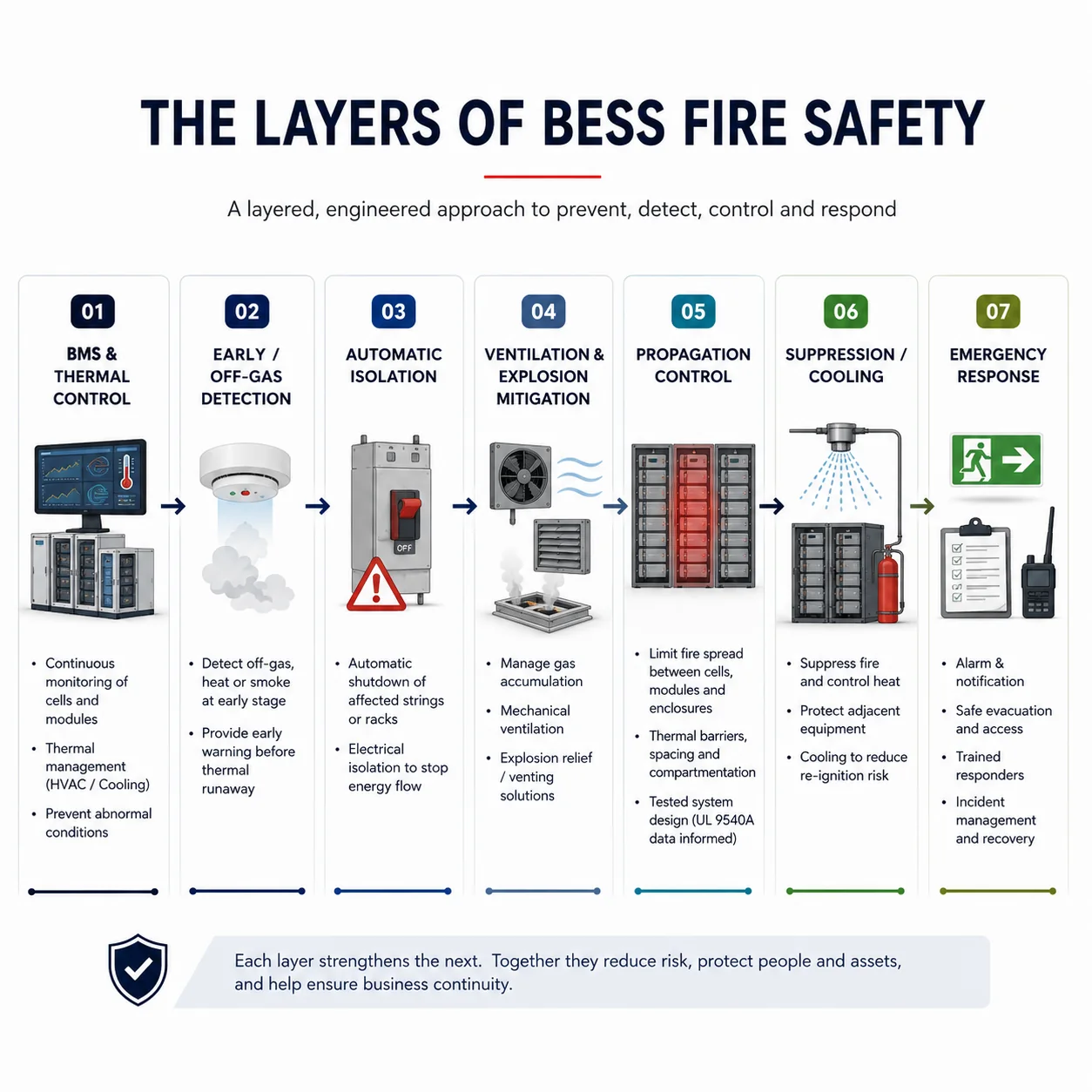
There is no single device that makes a battery-storage installation safe. A modern protection strategy should be built as a coordinated system.
Battery monitoring → abnormal-condition detection → early warning → isolation/shutdown → fire and gas detection → ventilation/explosion mitigation → propagation control → suppression/cooling → emergency response
Each layer has a different purpose.
The BMS may identify abnormal electrical or thermal behaviour. Specialised detection may provide additional warning of venting or fire. Automatic controls may isolate equipment. Ventilation and explosion protection may manage combustible gases. Physical design and tested separation may reduce propagation. Suppression and cooling may limit fire growth and protect exposures. Emergency planning determines what happens when automated systems are no longer enough.
The effectiveness comes from the interaction between these layers.
The Next Generation of BESS Safety Will Be More Predictive
The direction of battery safety technology is also changing.
Traditional fire systems are largely reactive: a hazardous condition develops and the protection system responds. BESS creates the possibility of moving further upstream.
Battery systems already generate enormous amounts of operational data. Voltage, current, temperature, state of charge and other parameters can be continuously monitored across large numbers of cells and modules. Gas sensors can add another layer of information.
More advanced diagnostic and predictive techniques are being researched to identify signatures associated with degradation or impending failure before conventional fire-alarm thresholds are reached.
This opens the possibility of a future BESS protection architecture that does not merely ask, “Is there a fire?” It asks, “Is this battery beginning to behave in a way that could eventually produce one?”
If that condition can be identified reliably, the system may have an opportunity to isolate the affected equipment before a major event develops.
The best battery fire is the one that never reaches the fire stage.
What This Means for India's Fire-Safety Industry
India's battery-storage expansion will require battery manufacturers, renewable-energy developers, utilities, EPC companies, electrical engineers and grid specialists.
It will also require people who understand what happens when those batteries fail.
For the fire-safety industry, that creates a new technical specialisation.
- BESS hazard and risk assessment
- battery chemistry and failure behaviour
- thermal-runaway propagation
- BMS and fire-system integration
- smoke, heat and off-gas detection
- ventilation and explosion mitigation
- emergency shutdown philosophy
- suppression and cooling strategies
- interpretation of UL 9540 and UL 9540A documentation
- separation and exposure protection
- emergency-response planning
- fire-service access and pre-incident planning
- inspection, testing and maintenance of the complete protection architecture
This is considerably different from simply supplying conventional fire-protection equipment to a battery facility.
It requires understanding the battery, the enclosure, the electrical system, the detection architecture, the fire dynamics and the emergency response as one interconnected risk.
That is why BESS fire protection is becoming its own engineering discipline.
India is building the storage infrastructure required for a more renewable and flexible electricity system. The fire-safety capability surrounding that infrastructure now has to develop just as quickly.
Engineering Note
BESS fire-safety requirements vary according to battery chemistry, system design, installation configuration, jurisdiction, project specifications and applicable codes and standards. Site-specific protection should be based on qualified engineering assessment, applicable statutory requirements, manufacturer documentation and relevant test data rather than this article alone.
Firetech Safety Systems provides fire-safety audits and risk assessment, detection and suppression engineering for industrial facilities. Contact the FTSS engineering team to discuss a project-specific assessment.