Clean Agent vs CO₂ Suppression: Choosing Right for Server Rooms
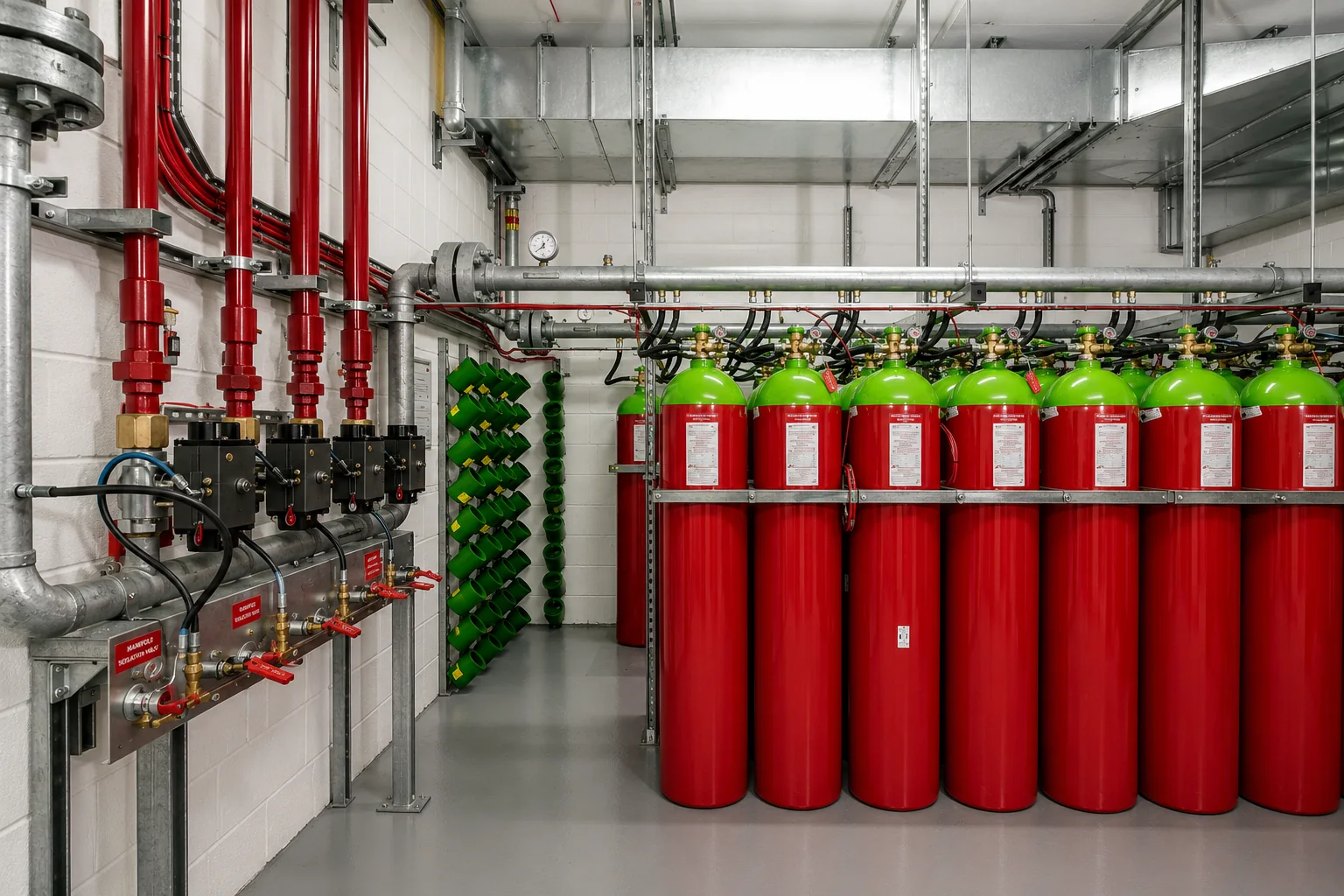
Hyderabad, India –
Water is the wrong answer in a server room, so the question becomes which gas. The choice usually comes down to one factor above all others: whether people can be in the room when the system discharges.
Clean Agents (FM-200, NOVEC 1230, IG-55)
Clean agents suppress fire without leaving residue and, at design concentrations, remain safe for occupied spaces.
- Safe for occupied areas at design concentration
- No residue — equipment survives the discharge
- Fast knockdown, typically within 10 seconds
- Higher agent cost per kilogram
- Requires a reasonably well-sealed room to hold concentration
Carbon Dioxide (CO₂)
CO₂ extinguishes by displacing oxygen. That mechanism is precisely why it is dangerous where people may be present.
- Lethal at extinguishing concentration — not for occupied spaces
- Very low agent cost
- Requires pre-discharge alarms, time delay and lock-off provisions
- Suited to unoccupied enclosures: switch rooms, generator sets, transformer bays
If a person can be inside the protected space, the decision is already made. Use a clean agent.
Firetech Safety Systems
Selection Criteria
- Can the room be occupied during discharge? This filters the options first
- Room integrity — a poorly sealed room will not hold a gas concentration
- Asset value against agent and refill cost over the system’s life
- Detection type: cross-zoned or aspirating for early, reliable initiation
- Post-discharge ventilation strategy
For most commercial server rooms in India, a clean agent with cross-zoned detection is the right specification. Reserve CO₂ for genuinely unoccupied plant spaces, and interlock it properly.